At a glance
Challenge
- The ‘Choosing a Course’ section of windesheim.nl needed to be even better tailored to the questions prospective students have
- Prospective students are increasingly turning to ChatGPT and other AI tools to find out more, even before they visit a university of applied sciences’ website
- Windesheim also wanted to secure a permanent place in AI-generated answers to questions about choosing a degree course
- The course pages were not part of the project. Everything took place in the ‘Choosing a Course’ section
Results
- Visibility in ChatGPT at 25.3%. The most visible of the eight universities of applied sciences monitored since August
- ChatGPT uses windesheim.nl as a source seven times as often: from 7 to 49 times per 100 replies
- Number 1 every week in Google AI Overviews since 13 April
- 90%: more visitors from ChatGPT
Starting point
It began with an AI-SEO workshop for Windesheim’s entire communications team. The key question was: how is AI changing the search behaviour of prospective students, and what does that mean for Windesheim’s online visibility?
What immediately struck me was that this team genuinely wants to help prospective students. Whether that’s a young person choosing a degree course or a professional looking to retrain. And those prospective students are increasingly turning to ChatGPT or Google AI Mode with their questions, long before they windesheim.nl end up. That is why we expanded the objective together: the university choice section needed to align even more closely with those questions, and consequently also be reflected in the AI’s responses.
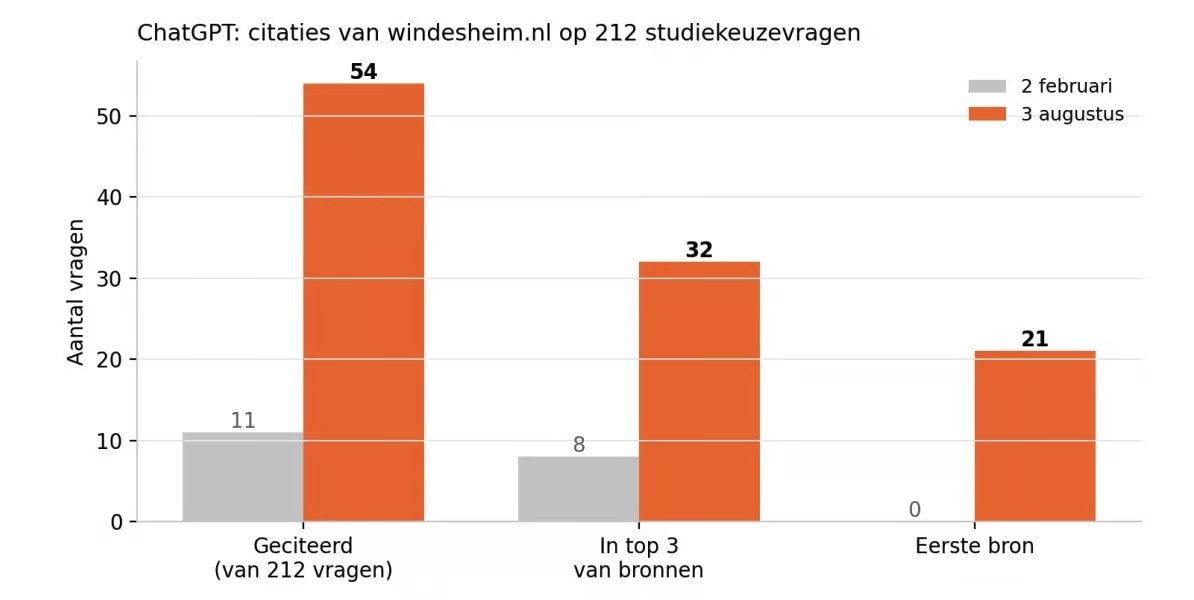
A baseline measurement in February 2026 provided the starting point. In Promptwatch, we asked ChatGPT, Google AI Overviews and AI Mode 117 general questions about choosing a course, without specifying a town or region and using seven other universities of applied sciences as a benchmark. In Advanced Web Ranking, we also tracked 212 questions. On Google, Windesheim was already performing well, ranking third in AI Overviews. We saw the greatest potential for growth in ChatGPT.
The approach
The existing content on choosing a degree course already provided a great deal of information. We wanted to tailor it even more closely to the paths that prospective students take. That is why we started with the prospective students themselves: what are they thinking about, and what do they want to know? Only then did we look at the website.
Step 1: Think like a prospective student
The key input came from a brown-paper session with the communications team. Based on Windesheim’s customer journey, we set out the questions prospective students have at each stage: orientation, exploration, in-depth research and decision-making. This revealed a clear difference between two groups.
Young people aged sixteen or seventeen who are choosing a course start by looking at themselves. What suits me? What do I enjoy? Which course is right for me if I’m good at biology? Next come questions about academic streams and careers, about the differences between related degree programmes, and only later about the university of applied sciences itself: what’s the atmosphere like, and will I feel at home there?
Being a professional starts with your own life. Am I too old to study? How many evenings a week will it take up? Will my employer contribute to the costs? The main issue here is whether a course of study is feasible and sensible.
Prospective students ask ChatGPT such questions in full sentences, and they do not appear in any list of search terms. An AI agent in Dust organised the results of the session. Using query fan-out, search term analysis and LLM research, we supplemented these with the sub-questions that Google and ChatGPT themselves ask. This resulted in a set of questions ranging from broad (“which higher professional education programme is right for me?”) to specific (“can I still make a career change at the age of 40?”).
Step 2: determining what information AI tools need about Windesheim
We automatically compared all the questions with the existing content. Which questions deserved their own page, and where could an existing page be expanded?
This is where it gets interesting. ChatGPT can answer some of the questions perfectly well using general knowledge. For questions such as “What sets Windesheim apart?”, specific information from Windesheim itself is required. The more specific the information is on its own website, the better AI tools will be able to incorporate it accurately into their answers.
Using a grounding analysis, we investigated which Windesheim-specific information was available online and could be used as a source for AI systems. Examples include:
- Which profile suits which Windesheim degree programme?
- Is Windesheim a place where I can feel at home?
- What support is available for dyslexia, ADHD or other special educational needs?
- In what specific ways does Windesheim differ from other universities of applied sciences?
Windesheim itself must be the primary source of information on these topics. Information about student support, course offerings, the atmosphere on campus and what sets Windesheim apart must therefore be presented clearly and be easy to find on its own website. Only then can prospective students, search engines and AI systems take this information into account.
Step 3: Targeted expansion of the university admissions section
Based on the set of questions and the grounding analysis, we expanded the existing structure to cater for two target groups: young people choosing a course of study and professionals. The programme pages themselves were excluded from the project. We therefore placed the answer where the question is asked: anyone wavering between two ICT programmes will look under the ‘ICT’ area of interest. That is where the comparisons were placed.
The new and expanded pages are tailored to different search paths, target audiences and stages in the decision-making process:
- From profile to degree programme, for prospective students looking for a course that matches their secondary school profile
- From a career to a degree course, for those looking for the right course based on their career aspirations
- How do you choose a higher professional education programme?, a practical step-by-step guide
- From vocational education (MBO) to higher professional education (HBO), aimed at students moving on from vocational education (MBO)
- Comparing courses, for each of the nine subject areas, featuring the questions that prospective students actually ask, such as “What is the difference between business administration and business economics?”
- Part-time study, for professionals: from a career change to balancing study with work and family life
- Studying at Windesheim, which sets Windesheim apart as a university of applied sciences
In total, there were 33 pages: 13 new, 18 expanded and 2 merged. Of these, 22 are aimed at young prospective students and 11 at professionals. The structure remained otherwise unchanged: no new main menu and, apart from the two merged articles, no relocated URLs.
Step 4: Writing in close collaboration
Onder produced the first drafts within four weeks. A custom GPT, programmed with Windesheim’s tone of voice and incorporating all previous feedback, acted as an additional editor, allowing the communications team to focus on the content. The team supplemented the texts with their knowledge of the degree programmes, student support and target audiences, whilst the study choice advisers reviewed the content. Every two weeks, we went through the feedback and any issues together.
In writing this, we opted for an advisory approach. The focus is on the choice the visitor has to make. This means providing concrete answers, honest assessments and Windesheim-specific information at the moments when it genuinely helps prospective students move forward.
The layout is also designed with the reader in mind. Heatmaps showed that visitors clicked frequently on the question-and-answer blocks. We therefore used short questions and direct answers, which a reader can scan quickly and which a language model can easily quote. In the same way, we also converted information on study costs and funding into questions and answers. Between 25 March and 1 April, Windesheim published the pages itself in the CMS.
Step 5: Assessing students’ needs
We selected the prompts we are measuring from the same set of questions. In Promptwatch, we ask the 117 questions using a persona: the young prospective student and the professional, each with their own set of questions. This way, the model responds as it would to that person. These are general questions without any place names, so Windesheim must prove itself on the basis of content when compared with the seven other universities of applied sciences.
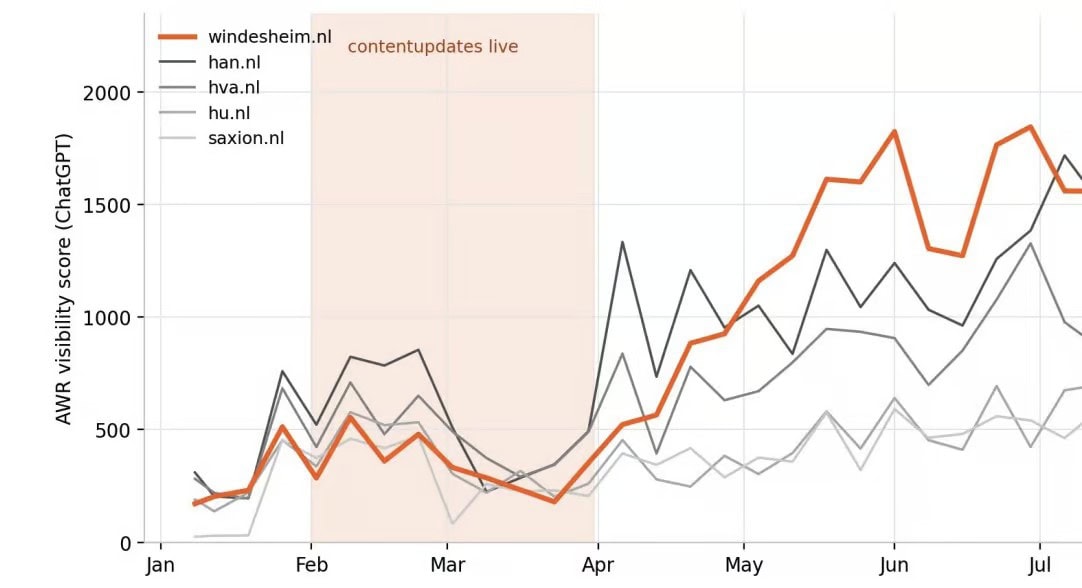
In addition, we track 212 queries every week in Advanced Web Ranking, for ChatGPT and AI Overviews. Using Google Search Console and GA4, we monitor clicks, visitors from ChatGPT and the transition to Studielink.
AI responses vary depending on the model, the moment and the user. That is why we carry out measurements using a fixed set of questions and over a period of several months. This allows you to see the trend.
Objectives and results
Based on the baseline assessment, we set three objectives in collaboration with Windesheim:
- Greater brand visibility in AI responses: to become the most visible university of applied sciences in ChatGPT within a year, and to continue growing in AI Mode and AI Overviews
- Used more frequently as a source: windesheim.nl is set to become the most cited university of applied sciences website, particularly its course selection section
- More clicks and impressions on Google for the course selection pages than in 2025, and faster growth than the site as a whole
ChatGPT: from second place to first place
The target for ChatGPT was achieved within six months. Visibility rose from 9.5% in February to 25.3% in September. Since August, Windesheim has been the most visible of the eight universities of applied sciences monitored, well ahead of the second and third-placed institutions in September (14.3% and 14.2%). ChatGPT mentions Windesheim twice as often, rising from 17 to 33 times per 100 responses, and mentions it earlier in the response: on average in position 2.5 rather than position 5.
Windesheim has also grown as a source. ChatGPT now cites windesheim.nl 49 times per 100 responses, compared with 7 times in February. Since August, windesheim.nl has therefore been the most cited university of applied sciences website in ChatGPT. Four of the ten most cited pages on windesheim.nl come from this project. Leading the way is “What is part-time higher professional education?”, a new page for professionals, with 438 citations in August and September. Only the homepage is cited more frequently as a source.
Google: number 1 in AI Overviews every week
In AI Overviews, Windesheim rose from 3rd to 1st place: since 13 April, Windesheim has been number 1 every week across the 212 questions. Its course choice pages are cited twice as often (17 to 34). In AI Mode, visibility rose from 22.8% to 38.2%. In standard search results, the degree programme pages received 36% more clicks from May to August than in the previous year, whilst the site as a whole remained unchanged (−1%). In July and August, when traffic on the site is typically low, growth was at its highest: +48%.
Visitors: more traffic from ChatGPT, more visits to Studielink
This increased visibility is reflected in visitor numbers. From 1 May to 27 September, there were 90% more visits from ChatGPT than in the previous year (3,553 to 6,747), whilst total visits to the site rose by 3%. The degree programme pages received 2.4 times as many visitors from ChatGPT. Visitors are also spending more time reading the pages: the reading time per page view increased by 14%, compared with 1% across the entire site.
And the number of people proceeding to enrolment also increased. From April to September, visitors clicked through to Studielink 21% times more often than in the previous year. The number of clicks originating from AI assistants was more than three times as high.
GEO starts with the person behind the question
A 17-year-old who’s unsure which degree programme suits her academic profile. A 45-year-old professional who wants to know whether it’s feasible to study alongside work and family life. The better you understand what’s on someone’s mind, the better your content will resonate. These are also the questions they ask ChatGPT and Google. That’s why we started offline, with pen and paper and the communications team, and had the study choice advisers review the texts.
The standard set of questions continues to be used. This allows us to see where new questions are emerging and which content needs further refinement. After all, if a 17-year-old asks ChatGPT what would suit her, Windesheim is the university of applied sciences she is most likely to be told about.











 Dutch
 English