

From click to conversation: How LLMs are fundamentally changing the customer journey
And how you can capitalise on this as a brand with AI SEO
For years, we as marketers have looked for footing in models. AIDA, STDC, the classic funnel - all attempts to capture the chaotic reality of a purchase decision in a clear, linear roadmap. But let's face it: those models were always a simplification.
Back in 2020, Google introduced the concept of the ‘Messy Middle’: a complex space between the initial trigger and the final purchase, in which consumers endlessly explore and evaluate information in a non-linear loop.
That ‘Messy Middle’ was already an accurate description of reality, but the advent of AI chatbots throws an accelerator on it. The loop of exploring and reviewing is now increasingly outsourced to an AI such as ChatGPT or Gemini. The reflex of “googling”, opening dozens of tabs and comparing reviews, is replaced by a single, conversational task: “Find me the best running shoes for a marathon runner with knee problems.”
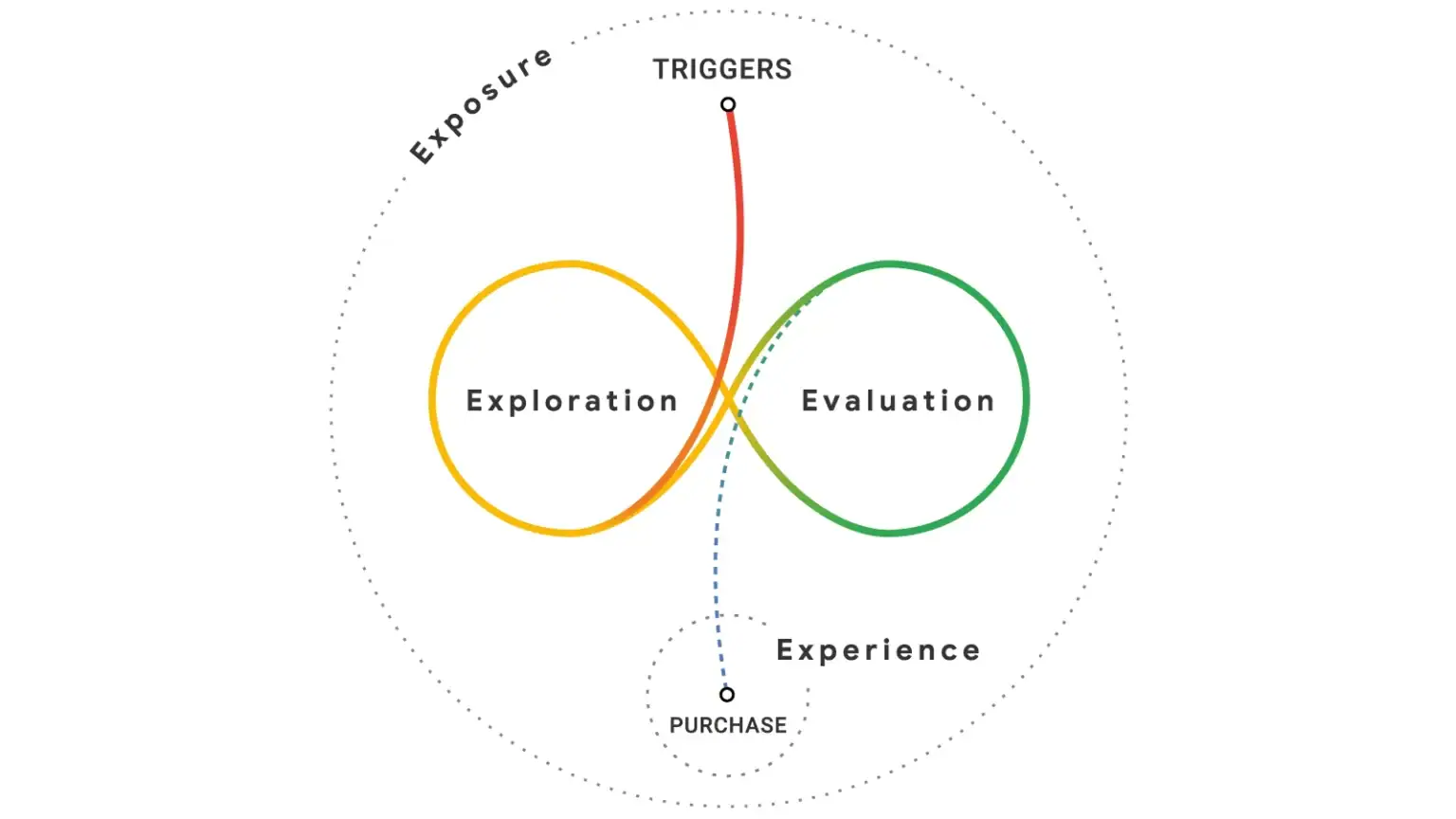
Source: Thinkwithgoogle.com
This is no small update; it is a fundamental shift in consumer behaviour. The customer journey is changing from a search we try to influence, to a conversation we need to be part of. The consequence for brands is twofold: less, but much higher-quality traffic, and a shift from the central question of “How do I rank number one?” to “How do I make sure my brand is trusted and that I am mentioned in the AI's response?”
In this article, we dive into this new reality. And not just about that the customer journey is changing, but most importantly how the technology behind it works and what you can do concretely as a marketer to position your brand at the heart of this new, AI-driven conversation.
From Library to Professor
To really understand the impact of this shift, a simple metaphor is useful. The traditional search engine, Google in the lead, functions like a giant library. You ask a question and get a neatly ordered list of books (the blue links) where the answer is possibly in it. It is then up to you, the user, to pull out the right books, read through the relevant chapters and form your own conclusion. You are responsible for filtering and synthesising the information yourself.
A Large Language Model (LLM) such as ChatGPT, Gemini or Perplexity takes on a fundamentally different role: that of the professor. This professor has already read all the books in the library, interpreted the information, made the connections and understood the nuances. If you ask the professor the same question, you won't get a book list, but a direct, composite answer, based on a synthesis of all that knowledge.
This seemingly small difference has a huge impact on marketing strategy. The consumer's consideration set is no longer formed in the ‘Messy Middle’ by visiting different websites, but is compiled directly in the AI's response. If your brand is not mentioned in the professor's synthesis, you simply do not exist for that growing group of consumers in the orientation phase. This definitely shifts the focus: from traditional SEO - optimising for a high position in the ‘book list’ - to SEO for AI: make sure your brand and expertise are so reliable, consistent and clear that the professor automatically cites you as a source.
How does the AI engine work? A peek under the bonnet for marketers
To understand how to influence the professor, we need to know how he arrives at his answers. Without getting too deep into the technical details, there are three concepts that every marketer needs to understand because they directly affect your strategy.
1. Pre-training data: static memory
An LLM's basic knowledge comes from his training dates. Think of this as a gigantic library that the AI has up to a certain date (the cut-off date) has ‘read’ and analysed. This forms his worldview: which brands have authority in which industry, what facts are common knowledge, and how concepts are related. Everything you have published up to that date in terms of content, blogs, and “about us” pages, contributes to this static memory. This is the basis of your brand reputation in the eyes of the AI.
2. Retrieval-Augmented Generation (RAG): actual memory
That static library is by definition outdated. For a question like “What were the key marketing trends of this quarter?” the AI needs to live the internet. This process is called Retrieval-Augmented Generation (RAG). In this process, the AI performs searches independently (usually in Google or Bing), scans the top results (say, the top 10), and uses that fresh information to enrich its answer.
The consequence for marketers is decisive: this is the direct and main link to your current SEO efforts. To appear in topical, purchase-oriented AI answers, a top position in traditional search results is necessary. Without that visibility, the AI simply cannot find you when it needs to update its knowledge.
Source: Antonis Dimitriou
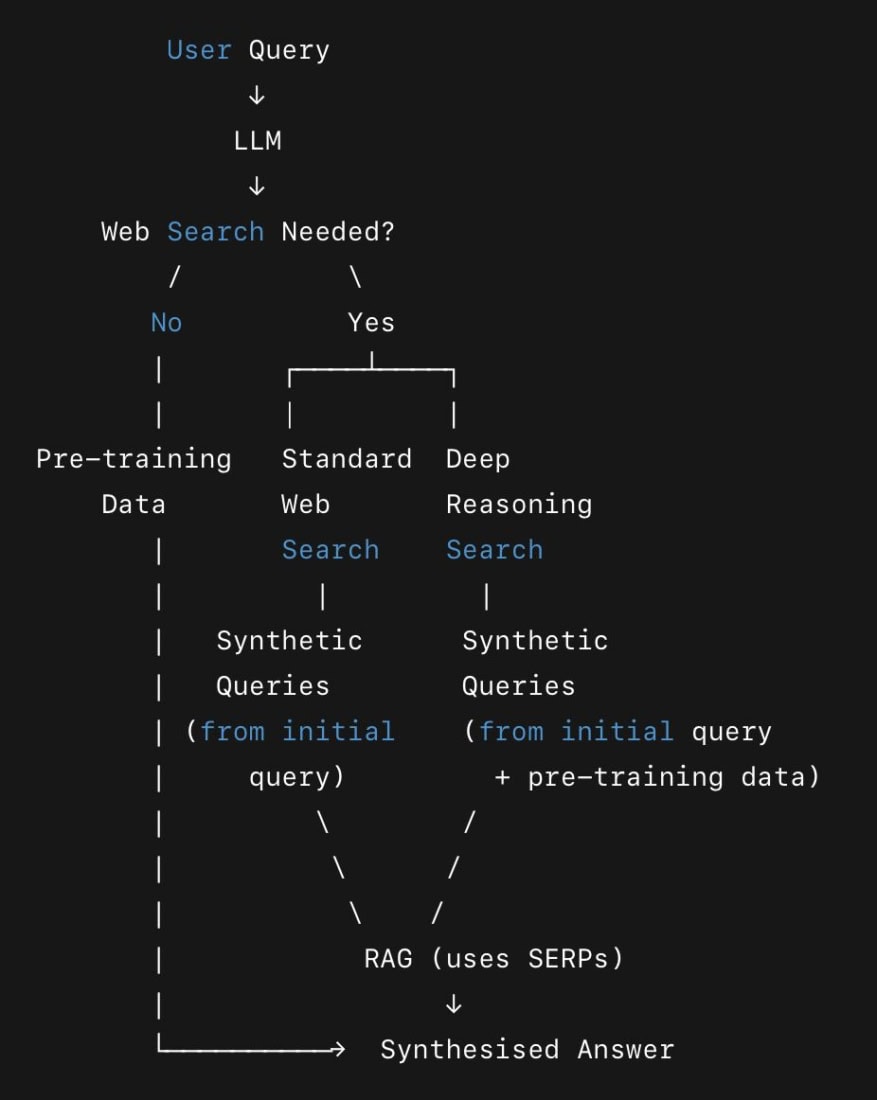
3. Query Fan-out: From a single question to a range of questions
A user often asks a broad question, but a good answer requires depth. This is why the AI internally breaks down a question like “Is an electric car for me?” into a range of sub-questions (Query Fan-out): “What is the range of popular EVs?”, “How long does recharging take?”, “What are the subsidy options in 2025?”, “Comparison maintenance costs EV versus petrol car”. The AI seeks answers to all these sub-questions and combines them into one coherent opinion.
The corollary: content that only covers the tip of the iceberg is insufficient. You need depth. Brands that are able to cover a topic from A to Z, paying attention to all possible sub-questions, are much more likely to be seen and used by the AI as a complete and valuable resource.
The practical approach: getting your brand ready for the AI era
The theory is clear. But how do you translate this into a concrete approach? The temptation is to dive straight into technical optimisations, but the most effective strategy starts not with a tool, but with a fundamental question: why should an AI trust you?
With content becoming increasingly easy to generate, authenticity is becoming the key differentiator. The basis of a successful AI SEO strategy therefore lies in your overall content and brand strategy. Ask yourself critically:
- What makes our brand unique and authentic? What is our story, our vision, our tone of voice that cannot be copied by an AI?
- What unique data can we share? Think of your own research results, customer data (anonymised), case studies with concrete figures, or unique insights from your own business processes. This is non-copyable, valuable information.
- Why are we an authority? What demonstrates our expertise, experience and trustworthiness? This is the core of E-E-A-T (Experience, Expertise, Authoritativeness, Trustworthiness), which is the blueprint for building trust, both in humans and AI.
The answer to these questions fuels the three pillars of your AI SEO approach: Content, Authority and Technology.
1. Content: make sure you are quoted
In the world of AI, the value of your content has shifted. It is no longer about ranking a page, but about delivering the perfect passage that the AI can use to build a response.
- From pages to passages: Optimise each paragraph as if it were a standalone answer. Provide a clear core message for each section. An AI scans your page looking for clear, self-contained blocks of information.
- Structure and conversational headings: Make it easy for the AI. Use a logical hierarchy (H1, H2, H3) and increasingly formulate headings as the questions your target audience is asking. A headline like “How our software increases productivity” is much more direct for an AI to interpret than a vague marketing term.
- Broaden your content scope: Think beyond the immediate visitor to your website. A potential client in an LLM might need a comparison between your product and the competitor's, or want to know the pros and cons of a particular technology. While you may not want to place this prominently on your homepage, creating this in-depth, comparative content on a knowledge base or blog is indispensable to feed the AI with all the information it needs to provide a complete answer.
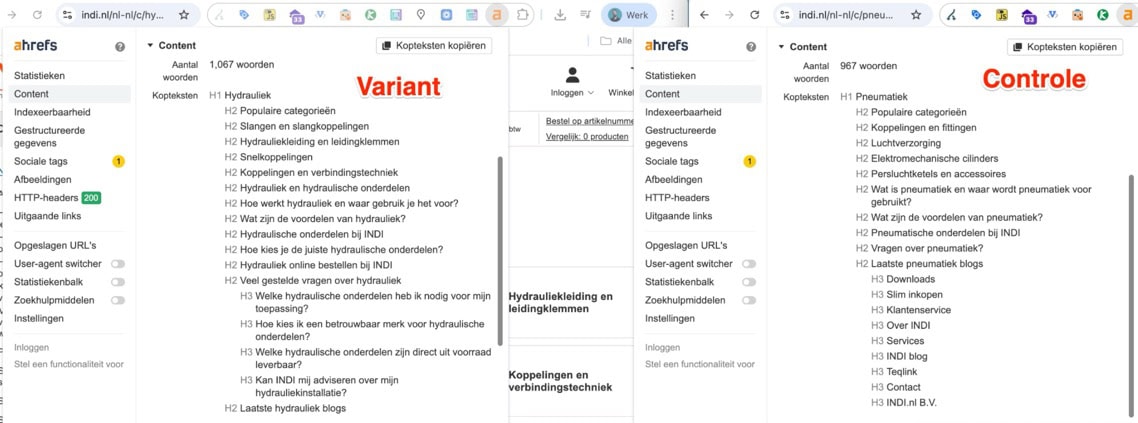
2. Authority: make sure you are trusted
An AI builds trust by both assessing your own expertise and reliability and seeking external validation. What do you communicate yourself, and what do others say about you?
- E-E-A-T on your own website: The basis of authority starts with your own brand. Make sure your expertise, experience and reliability are clearly and consistently communicated. Publish detailed author pages with demonstrable qualifications, show certifications and partnerships, and make it clear why your team is the authority in the field. Share concrete results, case studies with measurable outcomes and customer reviews. These cues help the AI recognise your brand as a trusted source, even before external validation enters the picture.
- From link building to brand building: The focus is shifting. A traditional backlink is still a valuable signal, but a trademark (even without a link) on an authoritative platform can carry just as much weight. It's all about associating your brand name with relevant topics in places the AI already trusts.
- The power of Digital PR: The most effective way to generate authority and brand mentions is to make the news yourself be. Invest in publishing original research. A well-known example is Independer's annual survey of the ‘most prolific’ speed cameras. This is simple, public data, wrapped in a newsworthy story. The result: hundreds of publications and brand mentions on national and local news platforms, positioning the brand as a trusted authority on data analysis - exactly what an AI is looking for.
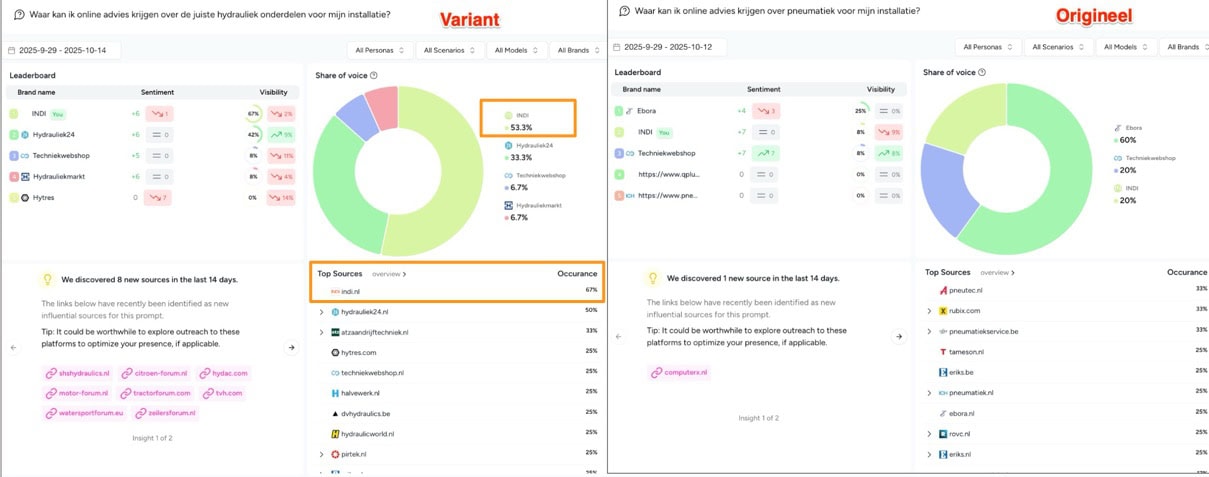
3. Technique: make sure you are found
The most brilliant content is worthless if technology creates a barrier.
- Getting the basics right: Crawlability is king: LLMs‘ crawlers (such as GPTBot and PerplexityBot) are less sophisticated than Googlebot. They mainly read the ’bare' HTML source code. So make sure your most important content is directly in the HTML and does not rely on complex JavaScript frameworks to be loaded. A simple test: look at your page with JavaScript turned off. Is the core of your content still visible?
- Other technical concerns: Make sure your Robots.txt file does not accidentally block these new crawlers. A fast load time is even more important, as an AI bot has less patience than a human visitor. A clear site structure with logical internal links helps the bot understand the context and hierarchy of your information.
The pitfalls and risks: navigating the Wild West of AI
The promise of AI is enormous, but the technology is far from perfect. We are in a kind of ‘Wild West’ phase, where the rules are still being written and reliability is not always guaranteed. For brands, this poses serious risks that require a proactive stance.
Hallucinations and the credibility of nonsense
The biggest risk is that LLMs can “hallucinate”: they present factual inaccuracies with convincing and confident aplomb. We saw this at the societal level around the elections, where chatbots gave unreliable voting advice. But it also happens at the brand level. Think of an AI firmly asserting that your product does not have a certain feature, that your company has gone bankrupt, or communicating the wrong price.
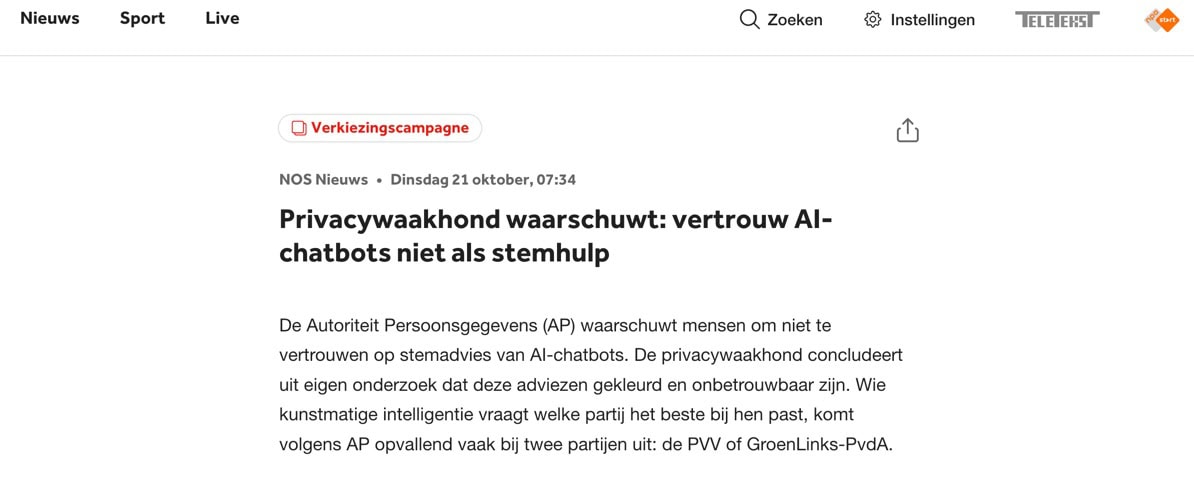
Source: Nos.co.uk / Personal Data Authority
The question is whether this improves in the short term. Scenario one is that training data and algorithms (partly due to the influence of E-E-A-T signals) will become increasingly sophisticated, increasing fact-checking. Scenario two is that this remains an intractable problem, because an LLM is at its core a word predictor, not a fact checker. Either way, the fundamental problem remains: people tend to believe an AI's answer. If misinformation about your brand is spread, that becomes the new truth for a subset of consumers.
Reputation management 2.0: become your own watchdog
Passively waiting is not an option. The most concrete action you can take today is to put your own brand through the wringer. Become the devil's advocate and ask the questions a discerning consumer would also ask:
- “What are the disadvantages of [your product/service]?”
- “Compare [your brand] with [competitor A] and [competitor B].”
- “What controversies are surrounding [your brand]?”
Analyse answers from different LLMs. Is the information correct? If not, the work begins: make sure there is an abundance of correct, consistent information on your own site and on external platforms, reinforced with E-E-A-T signals, to correct the narrative.
The black box of measurability
and other pitfall is the urge to measure everything. For now, the ROI of AI SEO is a ‘black box’. There is no ‘Chatbot Search Console’ that tells you exactly how many times you have been mentioned and what that has yielded. Still, we are not sailing completely blind:
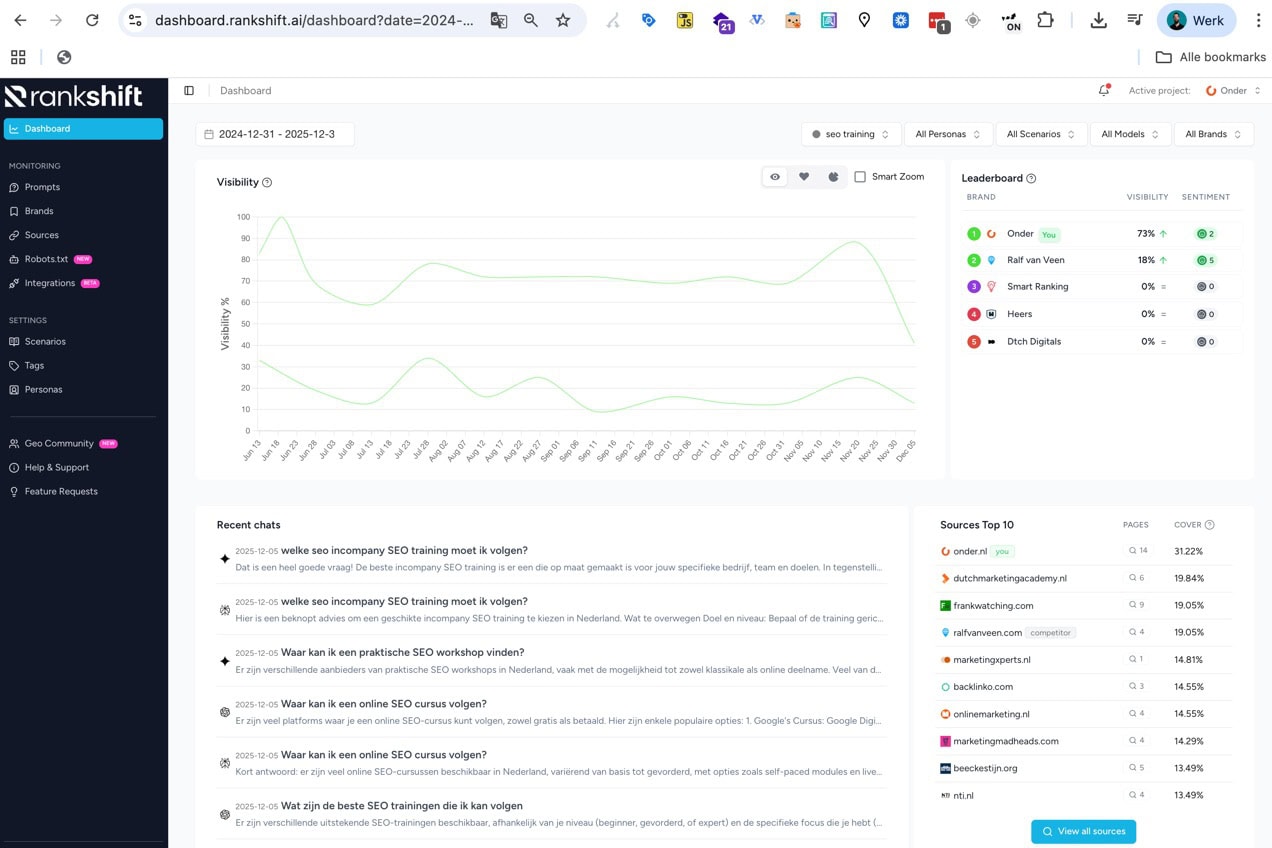
- Monitoring visibility: Tools like Rankshift or Promptwatch allow you to track your brand's visibility for a set of relevant prompts. While personalisation of AI responses makes this ‘debatable’, systematically comparing your own performance (‘apples to apples’) is a bright spot in the darkness. It gives an indication of your progress.
- Measuring traffic: Segmenting and monitoring your AI referral traffic in Google Analytics is a no-brainer. This traffic will only increase. For tech-savvy marketers, analysing server log files offers even deeper insights into how often LLMs‘ bots visit your website and what content they find ’interesting'.
Future: a big difference in adoption rates and on to the next phase
As we as marketers try to get a grip on the current changes, it is important to realise that not everyone is moving at the same pace. AI adoption follows a classic pattern, but at hyper-speed, leading to a growing gap in the market.
On the one hand, you have the early adopters. They are already deeply integrating AI into their daily lives and work. They use it not only to answer questions, but also for complex orientation processes, product comparisons and even for making purchases. For this group, the conversational customer journey is already the standard.
On the other side is the late majority. This, much larger, group may have just started experimenting. They use it occasionally, are more sceptical and still fall back on traditional search engines and direct website visits for their important decisions.
This dichotomy means that, as a brand, you have to play chess on two boards simultaneously for the time being. Your traditional SEO and online presence remain key for the majority, while with AI SEO you invest in the fastest-growing and most influential group of consumers.
The next phase is already here: Agentic AI
And just when we think we understand the current situation, the next, even more disruptive phase is already presenting itself: Agentic AI. This is the shift from a reactive AI (that answers a question) to a proactive AI agent that performs tasks on behalf of the user. Think of:
- A travel agent who not only gives options, but independently books the most efficient trip, including flight, hotel and transfers, within a given budget.
- A shopping agent that orders your groceries weekly based on your consumption and preferences.
- A research agent who conducts a complete market survey and summarises the key insights.
For these agents, there is no more ‘Messy Middle’; there is only a task and a set of data-driven criteria to execute it as efficiently as possible. Trust, availability, price, previous transactions and reliability of data become the hard currency. The brand that already invests in a flawless data infrastructure and a rock-solid, AI-recognised reputation will be the one chosen by the agent in the near future.
As a brand, what should you do with this?
The customer journey has fundamentally and irreversibly changed. The shift from a search through a list of links to a direct conversation with an AI is not a temporary trend, but the next logical evolution in how we consume information and make decisions. The ‘Messy Middle’ has not disappeared; it is increasingly being navigated by an AI co-pilot.
For marketers, this can feel daunting. Less control, a ‘black box’ in terms of measurability and a technological development curve that can hardly keep up. Yet the message is not that everything you knew should be jettisoned. The tactics underlying a successful AI SEO strategy - in-depth, quality content, building brand authority and a flawless technical foundation - are thankfully not a radical departure from what good marketing has always been.
The mindset needs to change, however. The goal is no longer just to rank in a list, but to be trusted and quoted by an AI that increasingly acts as the gatekeeper of information. This requires a relentless focus on authenticity. What is the unique story, the unique data or the irreplaceable expertise that only your brand can offer?
Start today. Dive into the AI chatbots and ask them about your own brand and that of your competitors. Think of the answers as an unvarnished, data-driven mirror of your current online reputation. And start building a brand so knowledgeable, trustworthy and authentic that the internet professor can't ignore you. Because in a world flooded with AI-generated content, real, human expertise is becoming the scarcest and therefore the most valuable commodity.
Share
Categorieën
Any questions?
Get in touch! :) we are happy to help you with all your SEO questions
SEO questionDon't miss it
Subscribe to our newsletter and don't miss a single SEO tip
"*" geeft vereiste velden aan










 Dutch
Dutch
 English